Showing posts with label politics. Show all posts

Saturday, February 27, 2016

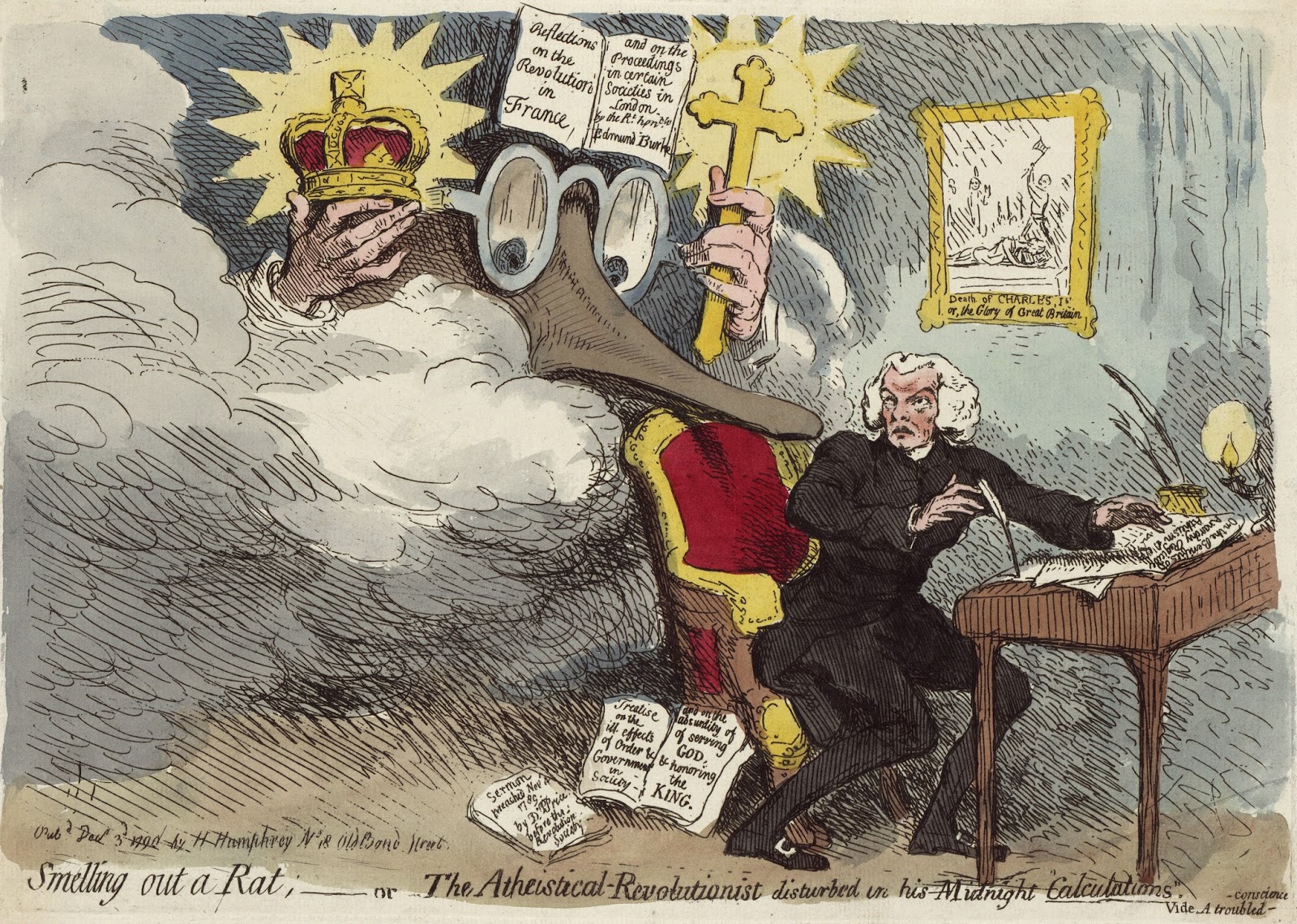
The Continuing Relevance of Edmund Burke's Political Thought


I recently started re-reading Burke's Reflections, and was struck by the continuing relevance of his argument to today's debates over social justice. I'm surprised that more political philosophers have not attempted a serious appraisal of his work. A former colleague recommended Yuval Levin's book, but it seems primarily intended for a popular audience.

There is also a convergence between Burke's view of the wisdom of inherited traditions and recent work on the evolution of human culture--I'm thinking specifically of Joseph Henrich's The Secret of Our Success. Henrich argues, inter alia, that the capacity to learn a culture is an evolutionary adaptation, and that a crucial element of this capacity is the ability to have faith in customs for which there is no known rational justification. Humans learn their society's culture largely by imitating others, with preferential imitation of people of high status.

An example that Henrich gives that has a Burkean flair is the set of customs practiced by some South American cultures related to the processing of manioc, a tuber which is a staple of their diet. The Tukonoan people, for example, engage in five separate practices--scraping, grating, washing and separating, boiling, and waiting two or more days--that involve great time and effort, but that greatly reduce the quantity of neurotoxins in the manioc--even though none of the Tukonoans have a rational justification for any of the practices, nor are they even aware of the presence of neurotoxins in the manioc. Ex hypothesi, many human customs and social institutions are similarly functional, even though we don't know what function they serve nor how they serve it.

Of course, there are presumably some "junk" customs and institutions in the mix, but attempting to institute radical, revolutionary change is seemingly bound to cause great harm and destruction by weakening or eliminating vital customs and institutions. This is relevant, too, to U.S. attempts to "nation build" in ways that do not sufficiently heed the matrix of existing customs and institutions in other societies.


Sunday, January 17, 2016

David Chapman on Buddhist Romanticism


Chapman also explains that the Illuminatus Trilogy was mainly intended as a critique of Eric Voegelin and the right-wingers of the 1960's and 70's who were influenced by his critique of communism, fascism, and other authoritarian utopian movements.

Tuesday, January 05, 2016

What Is the Theological Basis for Wheaton College's Decision to Fire Larycia Hawkins?


This Washington Post article attempts to clarify the theological issues surrounding Wheaton College's decision to fire Larycia Hawkins, but I remain confused after reading it. 

According to the article, Wheaton College decided to fire Professor Hawkins on account of her statement that Muslims and Christians worship the same God, and on account of the fact that Muslims and Christians have different views of the nature of God. Specifically, Christians believe in the doctrine of the trinity, while Muslims do not.

The problems with this explanation are twofold. The first is that not all Christians are Trinitarians, but non-Trinitarian Christians (such as Unitarians and Jehovah's Witnesses) are usually regarded as worshiping the same God as Trinitarian Christians. The second is that, more generally, it seems that Muslims and Christians (or members of any religion) could worship the same God (i.e., the same divine being) even if they have different theories about his nature (i.e., different accounts of the essence of that being). It is logically possible for different people to have an attitude towards or relationship with the numerically same being even if they have different beliefs about the being's ultimate nature. By analogy, a brother and a sister could both love their father if they had different beliefs about their father's character, or even about his underlying nature as a substance.

In fact, Muslims claim to worship the same God as Jews and Christians (the God of Abraham), they accept all of the same patriarchs and prophets as Jews and Christians (excepting only Muhammad), and they even accept that Jesus is the Messiah--so it is difficult to make sense of the claim that Muslims do not worship the same God as Christians. There are many disagreements between Muslims and Christians, but they do not appear to be in disagreement about which God they worship. (The matter is otherwise, for example, with Hindu monotheists, who do not universally identify the one God they worship with the God of the Hebrew Bible.)

Having said that, it is well within the rights of Wheaton College to fire a faculty member for not adhering to their theological requirements, but it seems they should do a better job articulating what those requirements are and how Professor Hawkins has violated them. 

What is made clear by the Washington Post article is that there have been several previous incidents in which Hawkins has offended the scruples of Wheaton College administrators, but the previous issues have more to do with politics and morals than with theology per se. Wheaton College should have the legal right to fire faculty who do not maintain their preferred political or moral beliefs, but it seems disingenuous to fire someone over an alleged theological dispute if the real problem lies elsewhere.

Update: Edward Feser already tackled this issue in much greater depth at his blog, and again in a recent post.

Sunday, August 16, 2015

Are Science Fiction and Fantasy Shockingly Offensive?


I actually agree with Lutgendorff that there's a lot of sexism in the science fiction and fantasy genres. But is not aesthetically sound to judge an entire genre using a single moral or political principle. I also agree with Lutgendorff's implicit assumption that morality is relevant to aesthetic evaluation, but her article seems to imply that it is the only or the most important principle of aesthetic evaluation, which is false. 

Perhaps Lutgendorff is not making an aesthetic argument at all, but rather a moral or political argument about the badness of the science fiction and fantasy genres. In that case, her argument still seems rather tone-deaf to the aesthetic merit of some of the works she discusses (Terry Brooks' Shannara novels excluded, inter alia). This seems to be an example of a larger social trend to reduce all of moral, aesthetic, and spiritual evaluation to gender politics or to some other narrow (if nonetheless important) political principle.

Friday, August 07, 2015

Of Lions and Poachers


"Hunting can be a valuable component to conservation. If a property has a hunting quota and that money comes back from hunting into the management of the land, it's not going to be at risk," he said. 
"So we have to be careful. The world reaction might polarise things and hunting might be banned outright. 
"I think we have to be very cautious about how this momentum can be used."
Many people have claimed that sport hunting can actually help conservation efforts, in large part because it gives landowners an economic incentive to try to protect and preserve populations of game animals, but it's interesting to hear similar thoughts being expressed by a researcher on the ground who was actually working with Cecil.

Wednesday, June 24, 2015

The Connection between Over- and Under-Policing

An article in New York Magazine discusses the making of a documentary film about "Grim Sleeper" serial killer Lonnie Franklin, Jr. The end of this article is noteworthy, for it raises the issue of the connection between over- and under-policing. Apparently, a lot of black neighborhoods are victims of both; police are overly zealous when it comes to handing out revenue-generating tickets for speeding and other infractions, but insufficiently zealous in investigating murders of low-status members of the community.

Tuesday, June 09, 2015

Blacks in the U.S.: 50 Years after the Moynihan Report


A recent piece in The Economist discusses persistent U.S. racial inequalities, 50 years after Daniel Patrick Moynihan's famous (infamous?) 1965 report. Among other things, blacks in the U.S. have much lower life expectancy, much greater rates of homicide and incarceration, and much less social mobility than do whites.
Fifty years later, black America still fares badly on many of the predictors of success and signals of distress that concerned Moynihan. If it were a separate country, it would have a worse life expectancy than Mexico, a worse homicide rate than Ivory Coast and a higher proportion of its citizens behind bars than anywhere on earth (see interactive). This is despite the fact that, overall, America is home to the richest, most successful population of black African descent that the world has ever seen.
The above graph shows the rise in both black and white out of wedlock births since 1965. The chart below shows how blacks have much less "social mobility" (specifically, mobility between income quintiles) than do whites:

Thursday, May 14, 2015

Politics and Primary Education

Quoth the headline: "Kansas could put teachers in prison for assigning books prosecutors don't like."

Perhaps the only way to keep politics out of the schools is to keep the government out of schools. Who's with me?

Didn't think so, but perhaps that's because you're a hypocrite! (Yes, you!) Conservatives and liberals alike need to remember that what's sauce for the goose is sauce for the gander.

Wednesday, May 13, 2015

David Simon on the Two Americas

David Simon is right that there are two Americas, but this is nothing new (the use of the word 'now' is misleading), and it doesn't relate to capitalism specifically.

Consider: Switzerland is a capitalist nation, but Simon's analysis of America's two nations wouldn't apply there in quite the same way, would it?

No, the original cause of the two Americas is the racial caste system set up after the enslavement of Africans in the 17th, 18th, and 19th centuries.

Saturday, March 21, 2015

Workers of the World, Invest!


Or, Socialist (in the sense of 'worker-owned') Capitalism: An Immodest Proposal.

This is from David D. Friedman's Machinery of Freedom, a libertarian classic from 1973 (still in print, and now in its third, revised edition) currently being reviewed by the incomparable Scott Alexander of the blog Slate Star Codex.

Alexander highlights the following passage from Friedman's book for our consideration, which, though I have read the book, I had quite forgotten about:
How much would it cost workers to purchase their firms? The total value of the shares of all stocks listed on the New York Stock Exchange in 1965 was $537 billion. The total wages and salaries of all private employees that year was $288.5 billion. State and federal income taxes totalled $75.2 billion. If the workers had chosen to live at the consumption standard of hippies, saving half their after-tax incomes, they could have gotten a majority share in every firm in two and a half years and bought the capitalists out, lock, stock, and barrel, in five. That is a substantial cost, but surely it is cheaper than organizing a revolution. Also less of a gamble. And, unlike a revolution, it does not have to be done all at once. The employees of one firm can buy it this decade, then use their profits to help fellow workers buy theirs later. 
When you buy stock, you pay not only for the capital assets of the firm—buildings, machines, inventory, and the like —but also for its experience, reputation, and organization. If workers really can run firms better, these are unnecessary; all they need are the physical assets. Those assets—the net working capital of all corporations in the United States in 1965—totalled $171.7 billion. The workers could buy that much and go into business for themselves with 14 months’ worth of savings.
As Alexander points out, under current conditions it would probably take longer for this to work, but the general idea still seems sound.

Of course, from Friedman's point of view, this is mostly a thought experiment to show that the workers actually benefit from the expertise of the owners of capital and the employees they hire to manage their capital and their workers. But, even if Friedman is correct about this, if his underlying argument is sound (perhaps a big 'if'!), then it seems that workers could still just purchase stocks in firms or otherwise become owners of capital themselves through saving and investing, thus de facto obliterating the distinction between workers and capitalists.

Of course, as many people have already pointed out, this has already partially happened, since a greater percentage of the population have investments in private corporations through their benefits packages etc., but Friedman's proposal suggests that this process could be greatly expanded and accelerated.

Saturday, March 14, 2015

Alice Dreger's Straight Talk (Ahem) on Sex and Gender


Tom Bartlett, in the Chronicle of Higher Ed, reviews Alice Dreger's recent book on the desultory effects of political correctness in the sciences. And Barron Lerner does likewise at Forbes. 

For background, here is an article in the Pacific Standard from 2014 by Alice Dreger in which she says interesting things about sex and gender (not just the usual yada, yada, yada). (Short version: sex and gender are partially socially constructed, but not entirely, and social justice warriors ignore this at their peril. I should note that Dreger does not use the politically loaded / emotionally charged term 'social justice warrior', but this is my 'short version' of her article, so I feel some creative license on my part is permissible. Gosh darn it; this explanatory note has now effectively rendered the adjective 'short version' false, or at least highly misleading, which gives me reason to rewrite the initial sentence so it no longer includes the politically loaded catchphrase 'SJW' in my description of Dreger's thesis. But I lack the motivation to do so. Sigh. Political debates are draining, dispiriting, and lead to a deep-seated psychospiritual ennui, beneath the superficial adrenaline rush of engaging in an in-group/out-group conflict. But what is to be done? You can take the primate out of the savanna, but you can't take the savanna out of the primate. Because the primate is not socially constructed like that. At least not entirely.)

Wednesday, March 11, 2015

Meet Aleksandr Dugin, the Intellectual Godfather of Russia's New Right


Crooked Timber offers a profile of Aleksandr Dugin, Russia's influential New Right / Eurasianist ideologue.

His geopolitical playbook makes for some scary bedtime reading.

And it appears that President Putin is a fan, in that he has proven to be a careful student of Dugin's playbook, judging by his actions in Ukraine and elsewhere; here is the wikipedia summary of Dugin's geopolitical strategy for Russia:
Military operations play relatively little role. The textbook believes in a sophisticated program of subversion, destabilization, and disinformation spearheaded by the Russian special services. The operations should be assisted by a tough, hard-headed utilization of Russia's gas, oil, and natural resources to bully and pressure other countries.
Here is a recent Wilson Center Occasional Paper on Mr. Dugin. And here is a Vice.com profile from 2014.

One thing I cannot figure out is why he uses Michael Moorcock's Sign of Chaos as a symbol of his movement:


Sunday, March 08, 2015

How the Federal Government Has Restricted the Rights to Freedom of Speech and Assembly

According to this article in the Los Angeles Times, since the days of the Selma march, the federal government has effectively banned large-scale protests on federal land, and federal court rulings have permitted states and cities to forbid the use of public property for the purpose of exercising the rights of freedom of assembly and freedom of speech.

I'm not sure what the implications of this are, but they don't seem good.

Granted, there could be very good reasons for the government to want to limit the exercise of the rights to free speech and assembly, but there's a real risk that the rights will be removed of any substance on account of these rules and rulings.

How wrong the Federalists who opposed the original Bill of Rights have proved to be. If memory serves, they argued that the Bill of Rights was unnecessary, because the Constitution does not permit the government to treat people in the ways explicitly forbidden by the Bill of Rights. Not only was the Constitution alone insufficient to protect the rights of the people, the government has effectively restricted and limited many of the explicitly enumerated rights, and often times has fought tooth and nail to restrict and limit such rights, until being constrained by the rulings of federal courts.

I am not actually a civil rights fanatic, as some libertarians and civil libertarians are, but nevertheless there is much wisdom in the attempt to systematically limit the exercise of government authority; and the Bill of Rights has turned out to be a useful means to this end, although by no means a perfect or optimal one.

What's disturbing is just how easy it appears to be for the government to gradually hollow out or remove the substance from our de jure rights, rendering them quite feeble de facto.

What's in a Word?


Rand Paul is proposing allowing same-sex couples to marry in all but name, through having contracts that are legally equivalent to marriage, but which are not called 'marriage'. 

It's extremely interesting to me that the debate over same-sex marriage has essentially devolved into who has the right to use the word 'marriage' to refer to their committed romantic relationships. It's as if the word 'marriage' has some magic power, some alchemy, that must not be let into the wrong hands.

I suppose it highlights the fact that politics is largely concerned with signalling commitment to values, including sacred values, rather than actually achieving measurable results or benefiting society in meaningful ways.

Another reason why I find myself so often to be simply Against Politics.

Saturday, March 07, 2015

Guerrilla Gardening and the Culture of TED Talks

Ron Finley gives an astounding TED talk on guerrilla gardening as community activism, education, art, and therapy.


One thing I will add here: TED audiences often come across as hopelessly . . . privileged.

Two caveats. First, I say this as someone who is no fan of the contemporary privilege-bashing rhetoric, through which large segments of the population are effectively removed from rational discourse through a kind of ill-conceived ad hominem. This is not to deny the reality of privilege, it's just that invoking privilege as a rhetorical tactic to shut down debate has a tendency to poison the well, strain social tensions, and hinder the unbiased and cooperative search for the truth.

Second caveat: I don't wish to engage in the widespread knee-jerk anti-TED ranting that is so common nowadays, and that was perhaps an inevitable outcome of the unprecedented success and popularity of the TED talk videos. A lot of the TED talks are grade-A presentations which manage the rare feat of being equally informative, amusing, and inspiring.

Okay, now for the critique. So often when I'm watching TED talks about very serious problems, including the one linked to above, the audience erupts into laughter at seemingly inappropriate moments. It's as if the audience's main goal is to be entertained or amused, and not to be informed or shocked out of their complacency. These people are hearing tales of poverty, disease, hardship, misery, and struggle, and their whole focus is on looking for any moment or a comment which can serve as an occasion for roaring with laughter.

Even as Ron Finley, the speaker in the above TED talk, was issuing his firm and serious call to action, the audience continued to merely laugh in response. What the Actual Fudge?! I get the impression that these wealthy TEDsters are so insulated from genuine hardship that they can't authentically empathize with the reality of others' suffering and struggles. Even their altruistic efforts come across as a type of half-hearted noblesse oblige, or (what's worse) as a type of pseudo-altruistic status-seeking, a type of social activist bling or a charitable feather in their cap. Perhaps I'm going too far here, but the question remains: HOW COULD THEY BE LAUGHING? HOW ON GOD'S GREEN EARTH COULD THEY BE LAUGHING?

Sunday, February 15, 2015

Scott Alexander on Political Activism

Five million people participated in the #BlackLivesMatter Twitter campaign. Suppose that solely as a result of this campaign, no currently-serving police officer ever harms an unarmed black person ever again. That’s 100 lives saved per year times let’s say twenty years left in the average officer’s career, for a total of 2000 lives saved, or 1/2500th of a life saved per campaign participant. By coincidence, 1/2500th of a life saved happens to be what you get when you donate $1 to the Against Malaria Foundation. The round-trip bus fare people used to make it to their #BlackLivesMatter protests could have saved ten times as many black lives as the protests themselves, even given completely ridiculous overestimates of the protests’ efficacy. 
The moral of the story is that if you feel an obligation to give back to the world, participating in activist politics is one of the worst possible ways to do it. Giving even a tiny amount of money to charity is hundreds or even thousands of times more effective than almost any political action you can take. Even if you’re absolutely convinced a certain political issue is the most important thing in the world, you’ll effect more change by donating money to nonprofits lobbying about it than you will be [sic] reblogging anything.

Saturday, February 14, 2015

Neoreaction, Redux


After reading some more about Curtis Guy Yarvin's (a.k.a "Mencius Moldbug") political philosophy, it seems my previous post on this topic may have contained some errors of interpretation. Specifically, I am no longer sure that Yarvin's argument against democratic republicanism is based on the Platonist view that a wise elite should rule over the foolish underclass. In fact, he argues for what he calls formalist neocameralism, which is basically the view that governments should be for-profit corporations which are accountable to their shareholders, but which do not make decisions based on popular elections or votes by representative bodies (such as parliaments or assemblies). This view does not obviously depend on the assumption that the rulers are or must be members of a wise elite. It seems to be a view about the most effective way of designing a political system to meet the goals of maximizing wealth and happiness of the members of society (or something to that effect).

The issues of interpretation are complicated by the fact that Yarvin's neoreactionary philosophy is really a bundle of views, each of which (or at least several of which) are logically independent of the others. For example, Yarvin does sometimes put forth elitist propositions as well as the propositions in defense of 'formalist neocameralism', even though it is not clear what the logical relationship between these propositions is supposed to be. I have heard tell that Yarvin has also asserted various racist and sexist propositions, although I have not yet found any of these (perhaps it's for want of searching; now, many of the commentators on his blog do frequently wallow in the racist/sexist/classist sewer, but it would be fallacious to accuse Yarvin of racism, sexism, or classism solely on the basis of the statements of his commentators).

In any event, the definitive guide and rebuttal to the neoreactionaries has already been written by blogosphere wunderkind Scott Alexander.

A Case of Conflicting Intuitions . . .

. . . Identified by the consistently brilliant Scott Alexander: If we have a moral obligation to vaccinate our children, because failing to do so risks the health of others, do we also have a moral obligation to technologically enhance our children's cognitive and other capacities, if failing to do so would risk the health of others?
I predict half the people will think I’m arguing against vaccination, half will think I’m arguing for mandatory designer babies, and a rare few wonderful people will understand that raising awareness of cases where our intuitions conflict is its own reward.

Monday, January 19, 2015

Martin Luther King, Jr's Role in Ending the Poll Tax


Writing for The Daily Beast, Gary May gives a long-form account of the part played by MLK in the congressional battles over ending the poll tax in 1965. May explains how the poll tax was used as part of a strategy to disenfranchise southern blacks de facto, even if they had the right to vote de jure. He also argues that ending the poll tax had a large beneficial impact on poor whites in the four southern states which continued to collect poll taxes at that time.